LED, LCD and ana-digi: a guide to vintage digital watches
Red LED displays, always-on LCDs and the ana-digi watches that put hands and a screen on the same dial. What each era was, what goes wrong with them, and what they cost now.
For about thirty years, from the early 1970s to the end of the 1990s, the digital watch was where all the interesting engineering happened. Mechanical watchmaking had reached a kind of settled maturity, and the energy moved to a red glowing display, then to a grey liquid crystal one, then to a resin case built to survive being dropped off a building. Those watches are now vintage in their own right, and they have quietly become one of the most rewarding corners of the pre-owned market.
This guide covers the three formats worth knowing: LED, LCD and ana-digi. What each one was, why it appeared when it did, what fails on them after forty years, and roughly what a good example costs today.
The 1970s and the red glow
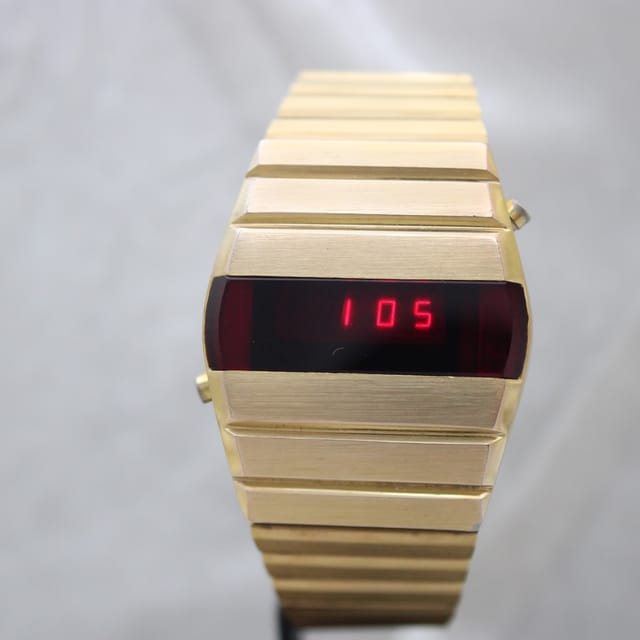
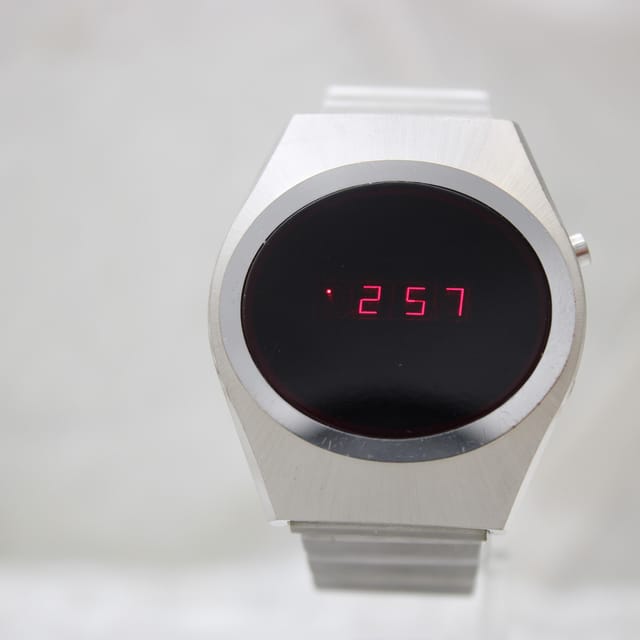
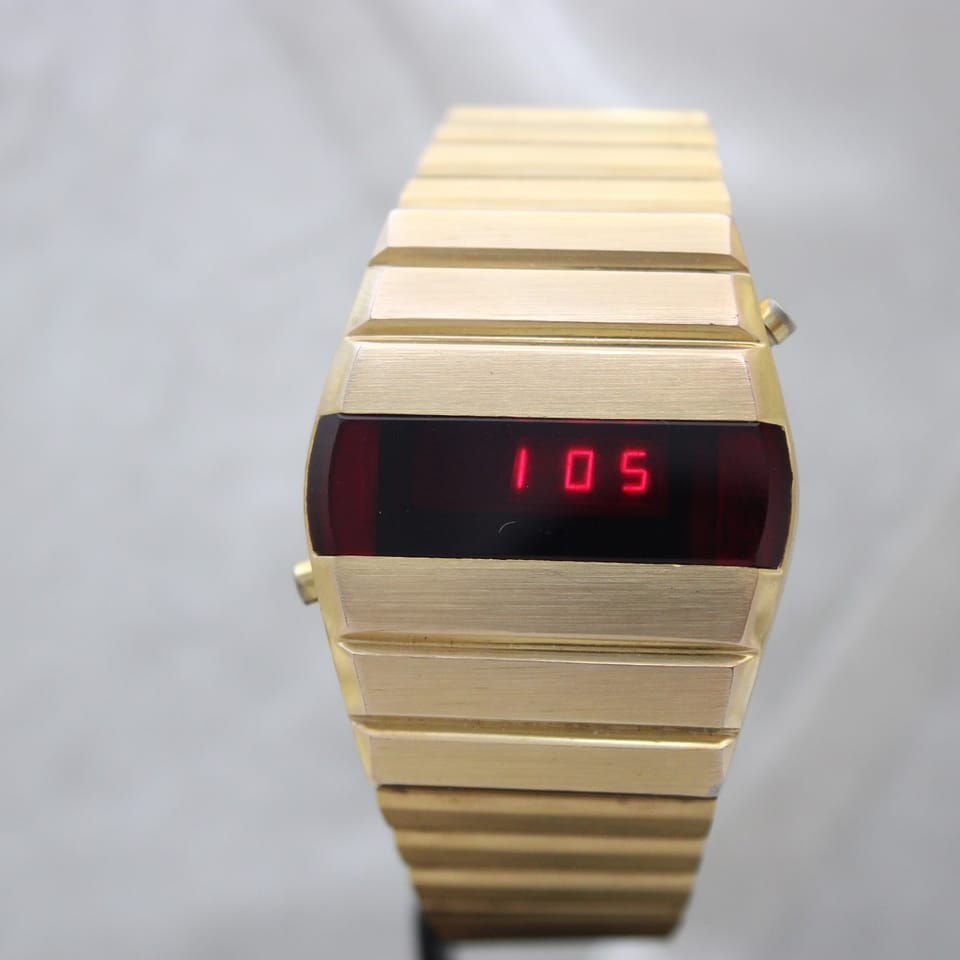
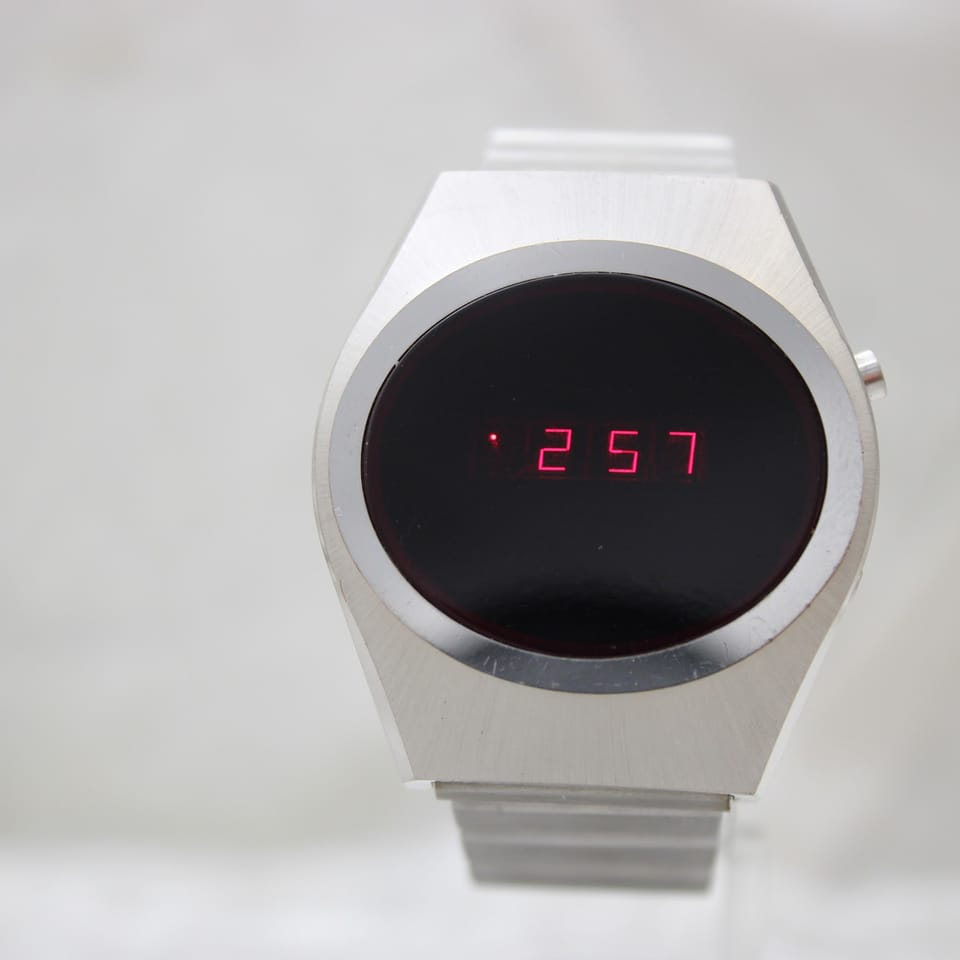
The first electronic watches to reach the public showed the time in red light-emitting diodes, and they arrived at the start of the 1970s carrying prices that now look extraordinary. Early examples cost as much as a car. Within four or five years mass production had pulled that down to something an ordinary person could consider, and the LED watch became the definitive object of the decade: chunky, angular, usually in a gold-tone or brushed steel case, and completely unlike anything that had come before.
The one thing everybody remembers is that the display was not always on. LEDs draw far too much current for that, so the time appeared only when you pressed a button, and it faded again after a second or two. Reading the time was a deliberate act rather than a glance. Collectors tend to find that charming now; in 1976 it was the main reason the format lost.
Our own vintage LED watches are a small group, which is normal for the format. Most of what survives from that decade is unbranded or carries a name that appeared for a few seasons and vanished, because the LED boom drew in dozens of makers who did not last. We currently have two unbranded 1970s pieces, one gold-toned and one silver-toned, and a CHRONEX in gold tone. Finding them with a healthy display is the whole difficulty.
The LCD generation that took over
The liquid crystal display solved the problem the LED never could. An LCD does not emit light, it reflects it, so it sips power instead of gulping it. That meant the time could simply sit there on the dial, permanently visible, on a battery that lasted years rather than weeks. By the late 1970s the always-on grey display had effectively ended the LED era.
What followed was one of the fastest price collapses in the history of consumer goods. A digital watch went from an aspirational purchase to something given away at a petrol station, and along the way it picked up an alarm, a stopwatch, a calendar and a backlight, all in a case a few millimetres thick. The watch stopped being jewellery and became an everyday tool, which is exactly why so many of them survive.
The pieces worth owning now are the ones where the design was actually considered. A classic steel-cased Seiko digital such as the A159-5009 has a purity to it that the throwaway plastic examples never had: a slim brushed case, a neat bracelet, a display with no wasted space. It looks entirely at home on a wrist today, which is not something you can say about most 1980s design.
Seiko's multi-function era
Seiko treated the digital display not as a cheap alternative but as a platform. Through the late 1970s and 1980s the company built alarms, chronographs, timers, dual time zones and calendars into modules that were genuinely clever, and it gave them a reference system that collectors still use to navigate the range. The A-series covered the all-digital modules, the H-series the analogue-digital ones, and the number after the letter tells you which module is inside.
It is a satisfying corner to collect precisely because it is legible. Once you know that a reference beginning A is a pure digital and one beginning H has hands as well, a wall of unfamiliar model numbers resolves into something you can read. Our own examples run to the A159-5009 in steel, the ana-digi H448-5000, and the rectangular E029-5540, a ladies' piece that shows how far the format travelled from the sports-watch stereotype.
Two references we have already sold, the A229-5060 and the H556-5030, give a sense of how quickly the good ones move. If a particular Seiko module interests you it is worth checking our Seiko collection regularly rather than waiting, since these come in one at a time.
Casio and the indestructible watch
Casio's contribution was to ask a different question. Rather than making the display better, it asked how a watch could survive being treated badly, and the answer, arrived at in 1983, was to suspend the module inside a hollow resin case so that shock never reached it directly. The G-Shock is the result, and it changed what people expect a watch to put up with.
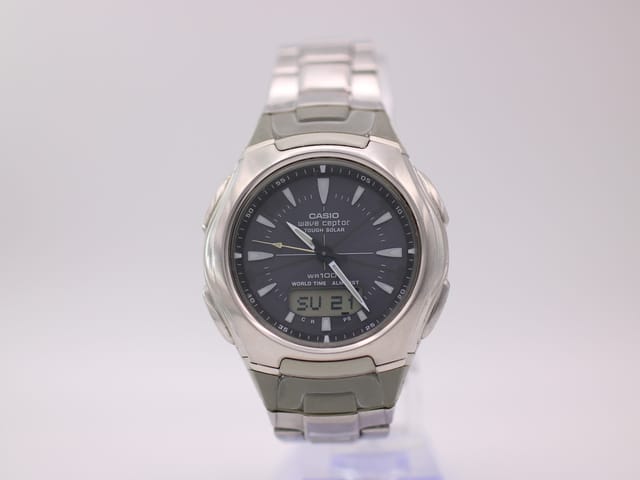
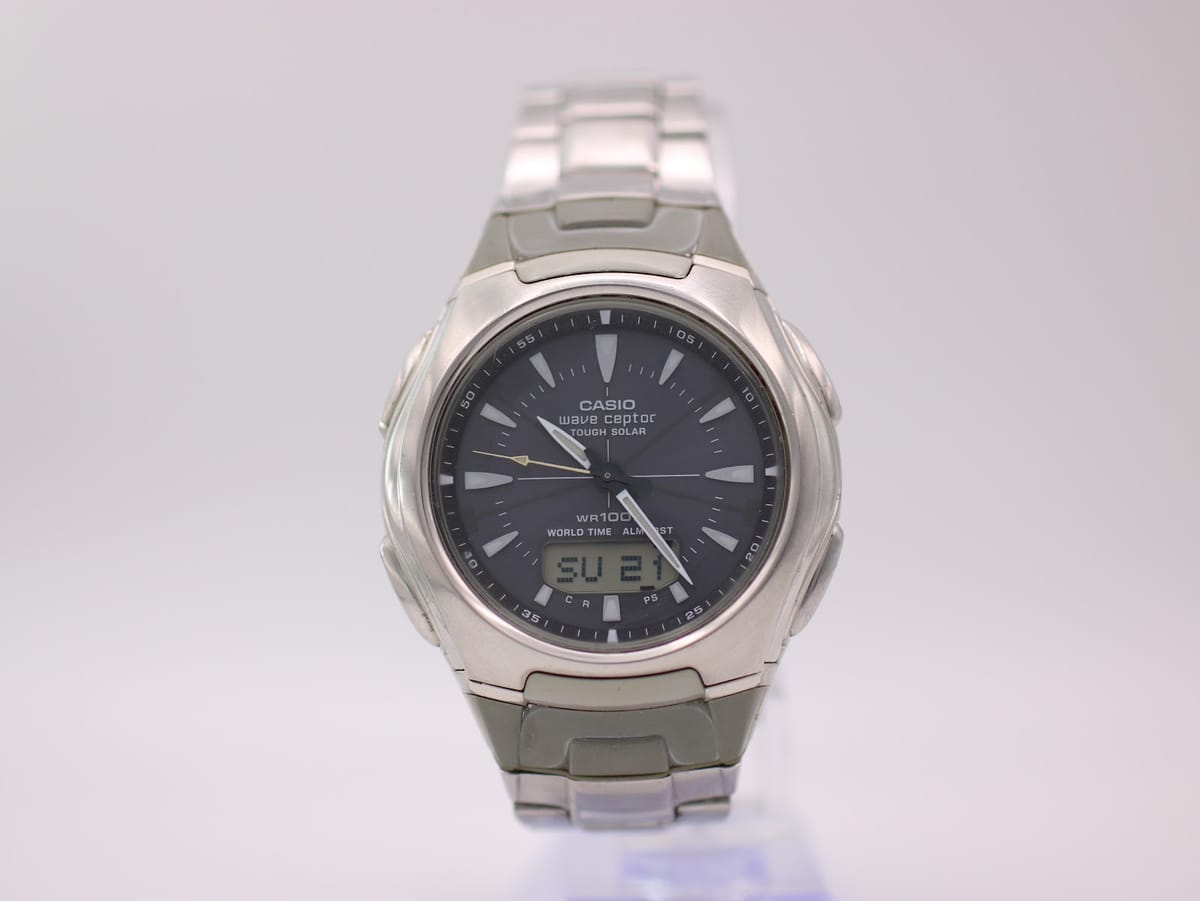
The design has barely needed revising since, which is why a G-Shock from twenty years ago still feels current. Ours include the GA-110 and GA-110C, the GA-300, the GDF-100, the G-300, the GMA-S110MP in the smaller mid-size case, and the GW-1500A. Alongside them sits the Wave Ceptor WVA-430U, which sets itself from a radio time signal rather than being set by hand, and a Junghans Mega Solar Ceramic that does the same thing in a ceramic case with an analogue dial and a small digital window.
These are the most wearable watches in this guide by some margin. A resin G-Shock asks nothing of you beyond a battery every few years, and the market has not yet decided that they are collectable, which keeps them sensible to buy.
Ana-digi: hands and a display together
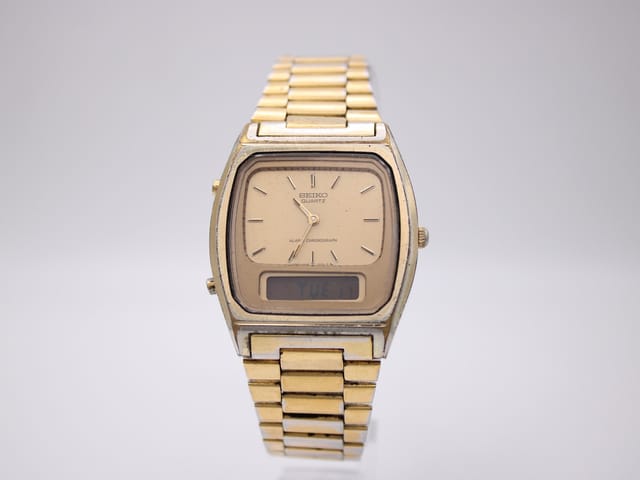
The ana-digi format puts a conventional analogue dial and a small digital display on the same face. It sounds like a compromise and it was: the hands gave you the at-a-glance reading that people were used to, while the display added the alarm, the second time zone and the stopwatch that hands cannot do well.
What is interesting is that the format never really went away. It arrived in the late 1970s, defined a certain kind of 1980s watch, and has been revived by more or less every major maker since, because the reasoning behind it still holds. Two ways of showing time on one dial is genuinely useful, and it looks busy in a way that a lot of people find appealing rather than cluttered.
Our ana-digi watches include the Seiko H448-5000, the Citizen C480, the rectangular Seiko E029-5540, and the Junghans Mega Solar Ceramic. They are a good place to start if a fully digital display feels like too much of a jump, because you can still read the time the ordinary way and treat the display as a bonus.
These are vintage watches, not smartwatches
This is worth stating plainly, because the word digital now means something different to most people than it did in 1978. Every watch in these collections is a vintage or pre-owned quartz watch with an electronic display. None of them is a smartwatch.
There are no apps. There is no charging cable and no charging pad, because there is no rechargeable battery. There are no notifications, no messages and no calls. There is no step counting, no heart rate, no sleep tracking and no GPS. Nothing pairs with your phone, and nothing needs your phone to work, because these watches were designed and built before the smartphone existed.
What they do instead is tell the time, and depending on the model an alarm, a stopwatch, a calendar or a second time zone. A standard cell keeps one running for somewhere between two and five years, and when it stops a watchmaker fits another one for a few pounds. The display on a 1980s Seiko has been showing the time continuously, on and off wrists, since before the internet was a consumer product. That is the appeal, and it is close to the opposite of the appeal of a modern wearable: an object that keeps working on its own terms, needing no software, no account and no support from anyone.
What to check before buying
Display first, always. The classic failure on an LCD is display rot, where moisture gets past the seal and the liquid crystal degrades, leaving dark blotches, faded areas or a cloudy grey wash across the numbers. Dead segments are the related problem: a figure eight that only ever shows part of itself, usually caused by a failing connector between the module and the glass. Both are visible in a photograph, so insist on seeing the display lit and showing an eight in every position before you buy.
On LED watches the equivalent check is whether every digit still lights, and whether it lights at the same brightness. LEDs dim with age and individual diodes fail, so a display where one number is noticeably weaker is telling you something.
Then the battery. Some 1970s and early 1980s modules were designed around cells that are no longer manufactured, and while adapters and modern equivalents exist for many of them, it is worth confirming what a watch takes before you commit rather than after. Ask the seller what is in it now.
After that, the case. Vintage resin goes brittle and cracks around the lugs and the strap bars, and that crack is structural rather than cosmetic. Check pushers are all present and that they spring back rather than staying depressed. Look inside the caseback if the seller has photographed it, since green or white powdery corrosion around the battery contacts is a leaked cell, and a leaked cell often means a module that will never run properly again. As with any watch of this age, assume no water resistance whatever the caseback claims, because the gaskets hardened decades ago.
What they cost now
Digital watches remain one of the last genuinely affordable areas of vintage collecting, mainly because they were made in enormous numbers and because the collector market took a long time to take them seriously. Prices below are what clean, working examples with healthy displays typically sell for in the UK pre-owned market. They are a guide rather than a quote, and display condition moves them more than anything else.
| Era | Display | Typical makers | What to check | Typical price |
|---|---|---|---|---|
| 1970s LED | Red LED, lights on a button press | Mostly unbranded and short-lived names | Dim or dead digits, uneven brightness, obsolete cells | £80 to £300 |
| Late 1970s to 1980s LCD | Always-on grey liquid crystal | Seiko, Casio, Citizen | Display rot, dead segments, plating wear on steel-look cases | £40 to £150 |
| 1980s multi-function | LCD with alarm, timer and calendar modules | Seiko A-series and H-series, Citizen | Failing pushers, module corrosion, weak contrast | £70 to £250 |
| 1990s to 2000s G-Shock | LCD in a shock-resistant resin case | Casio and G-Shock | Cracked resin at the lugs, worn straps, backlight failure | £50 to £180 |
| Ana-digi | Analogue hands plus a small digital window | Seiko, Citizen, Junghans | Hands and display running out of step, faded window | £60 to £250 |
Where to buy
Every digital watch in our vintage digital collection is bought individually, inspected and tested in London, and given a fresh cell where it needs one. The display is photographed as it actually looks rather than staged, because on this kind of watch the display is the watch, and any fading, rot or weak segment is described rather than cropped out.
Free UK delivery and 14-day returns apply throughout, so a display you have only seen in photographs can be judged on your own wrist. If you want to understand why these watches existed at all, our piece on the quartz revolution covers the technology shift that made them possible, and our guide to watch movements explains how quartz compares with mechanical in daily use.
Frequently asked questions
Are vintage digital watches the same as smartwatches?
No. A vintage digital watch is a quartz watch with an electronic display, made mostly between the 1970s and the 1990s. It has no apps, no notifications, no fitness tracking and no connection to your phone, and it does not need charging. It runs on a standard cell that a watchmaker replaces every few years, and its functions are limited to things like the time, a date, an alarm, a stopwatch or a second time zone.
What is display rot on a vintage digital watch?
Display rot is the degradation of the liquid crystal layer in an LCD, usually caused by moisture getting past an aged seal. It shows as dark blotches, cloudy grey patches or faded areas across the numbers, and it is permanent, since the display cannot be repaired economically. Always ask to see the display lit and showing an eight in every digit position before buying, because rot and dead segments are both obvious in a clear photograph.
Can you still get batteries for vintage digital watches?
For most of them, yes. Watches from the 1980s onwards generally take standard silver oxide or lithium cells that any watchmaker stocks. Some 1970s and early 1980s modules were built around cells that are no longer manufactured, though modern equivalents and adapters cover many of those cases. It is worth asking a seller what cell a particular watch takes before you buy rather than finding out afterwards.
Are 1970s LED watches collectable?
Increasingly so. They were made for only a few years before LCD replaced them, a great many were thrown away once the novelty passed, and the ones that survive often have dim or failed digits. That combination of short production, low survival and a display that is difficult to preserve is what makes a fully working example desirable. Branded pieces from the better-known makers command more than unbranded ones, but condition of the display matters more than the name.
How accurate are vintage digital watches?
Very accurate by mechanical standards. A quartz digital watch typically keeps time to within about fifteen seconds a month, where a good vintage mechanical watch might drift that much in a day. Radio-controlled models such as a Casio Wave Ceptor or a Junghans Mega go further and set themselves from an atomic time signal, so they need no adjustment at all while they are within range of the transmitter.