Quartz, automatic, or manual: a guide to watch movements
Every watch is powered by one of three things: a battery, the motion of your wrist, or your own hand. Understanding the difference is the first step to buying well.
Every watch ever made runs on one of three things: a battery, the motion of your wrist, or your own hand. Those three options give us the three movement types, quartz, automatic and manual, and the one a watch uses shapes almost everything about living with it. It decides how accurate the watch is, how much looking-after it needs, how thick it sits on the wrist, how it feels and often what it costs. If you are just starting to look at vintage and pre-owned watches, this is the first thing worth getting straight.
Manual wind: the original
The manual-wind movement, also called hand-wound, is the oldest of the three and the easiest to picture. Inside sits a coiled spring, the mainspring, which stores the energy. You turn the crown to wind it, and as it slowly unwinds it drives the gears that move the hands. Once it runs down, the watch stops. Most manual movements hold roughly thirty-six to forty-eight hours of running time, so a watch you take off overnight will usually still be ticking in the morning, while one left over a weekend will want winding and resetting.
There is a small ritual to a manual watch that a lot of collectors grow fond of: a few seconds of winding each morning, a quiet bit of contact with the thing on your wrist. With no winding rotor taking up space inside, manual movements are also the slimmest, which is why so many of the most elegant vintage dress watches are hand-wound. If you like a watch that sits thin under a cuff and keeps you involved in keeping it going, start here.
Automatic: powered by motion
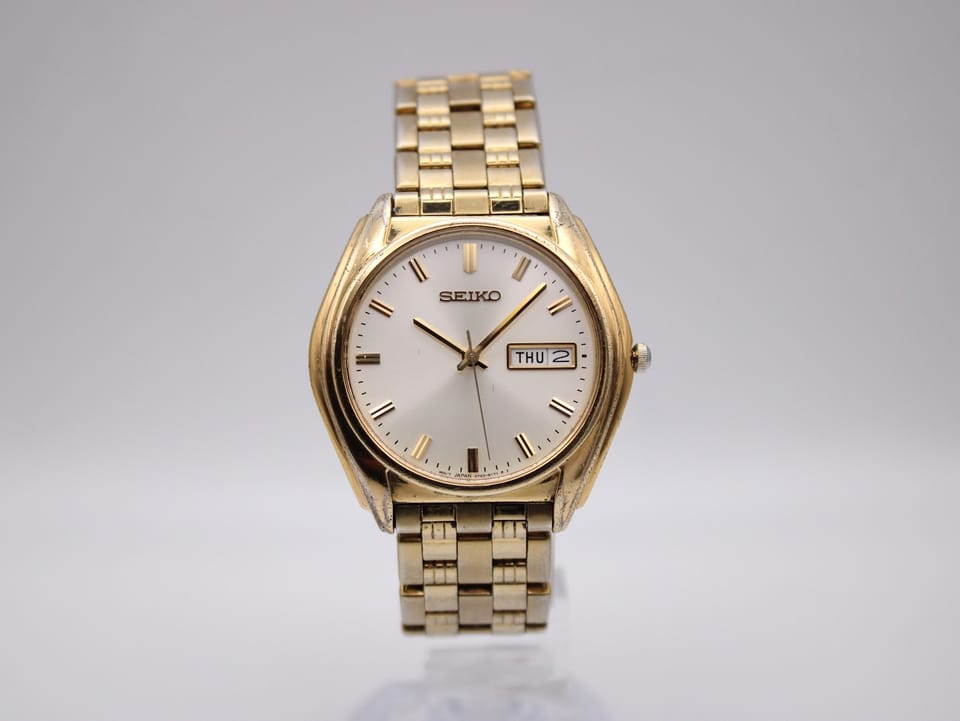
An automatic, or self-winding, watch is really just a mechanical watch with one clever addition. A weighted rotor inside swings as your wrist moves and winds the mainspring for you. Wear it most days and you never need to touch the crown; your own movement keeps it going. Leave it off for a day or two and it will wind down and stop, like any mechanical watch, and a few turns of the crown or a gentle shake will bring it back.
You pay for that convenience in two small ways. The rotor adds a couple of millimetres of thickness, and there is a little more going on mechanically. Automatics are the engine of vintage sports and tool watches, from the Seiko 6309 diver to the great Swiss automatics of the 1960s and 1970s and the everyday Seiko 5. If you want something that simply runs for as long as you wear it, and you enjoy the weight and presence a mechanical movement brings, an automatic is the obvious choice.
Quartz: precision and convenience
A quartz movement works in a completely different way. A small battery passes a current through a tiny quartz crystal, which vibrates at a steady 32,768 times a second. The circuit counts those vibrations and turns them into one clean step of the seconds hand every second. The pay-off is accuracy a mechanical watch cannot touch. A decent quartz watch keeps time to within a few seconds a month, where a mechanical one is doing well to hold a few seconds a day.
Quartz arrived on Christmas Day 1969, when Seiko launched the Astron, the first quartz wristwatch, and it reshaped the whole industry inside a decade. For an owner today it means very little fuss: a fresh battery every two or three years and not much else. That makes it the easiest way into vintage watches, and it is why so many good-looking dress watches from the 1980s and 1990s can be bought and worn with almost no commitment.
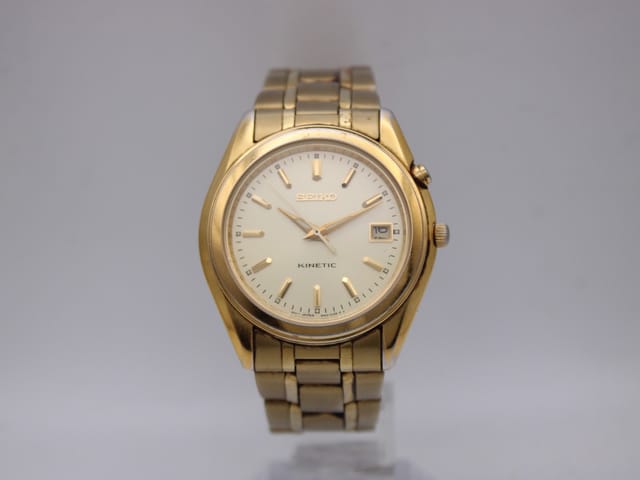
There are some nice twists on the idea, too. Seiko's Kinetic movements use the motion of your wrist to charge a small cell instead of a throwaway battery, and Citizen's Eco-Drive does the same job using light. Both are quartz underneath, just as accurate and easy to live with, but they spare you the battery changes.
How to tell which one you have
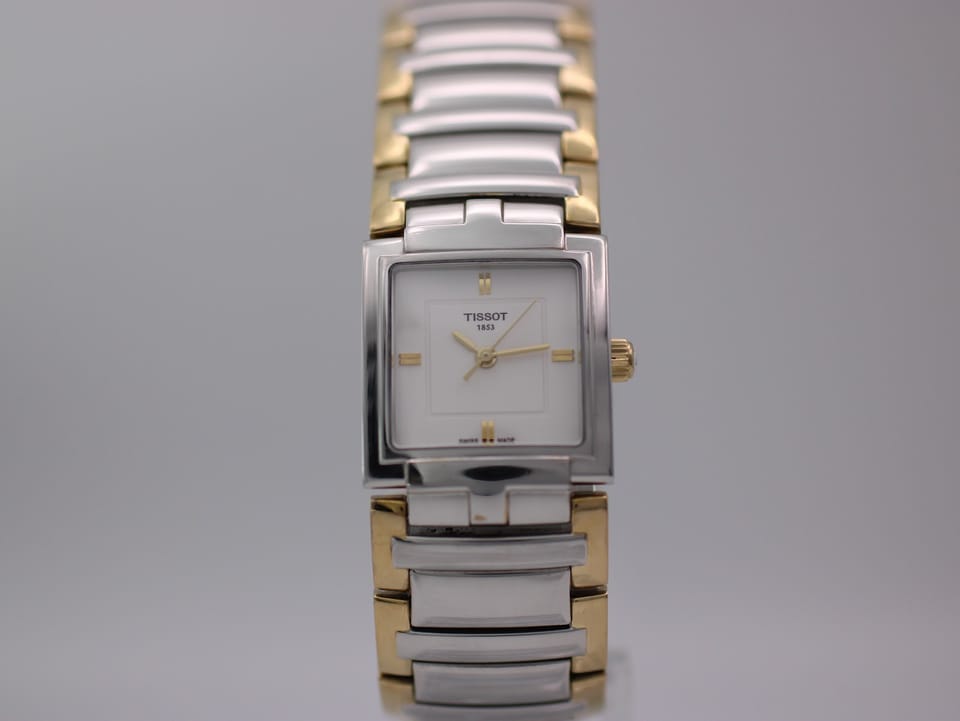
The fastest check is the seconds hand. A quartz watch ticks once a second, in clear separate steps. A mechanical watch, whether manual or automatic, sweeps instead, the seconds hand gliding in tiny steps that look almost smooth. If it glides, it is mechanical. If it ticks once a second, it is quartz.
Telling a manual from an automatic usually comes down to the case back. Mechanical watches often print a jewel count such as "17 jewels" or "21 jewels", and automatics are frequently marked "automatic" or "self-winding". A watch that only keeps running if you wind it by hand each day, with no "automatic" written on it anywhere, is almost certainly a manual. If the case back gives nothing away, the behaviour will: an automatic picks up power as you wear it or give it a gentle shake, a manual only when you turn the crown.
Which is right for you
There is no best movement, only the one that fits how you actually want to live with the watch. Want the least upkeep and the sharpest accuracy? Go quartz. It is honest, dependable and often brilliant value on the vintage market. Want something that comes alive as you wear it and carries the heft of a real mechanical movement? An automatic. Drawn to a slim case, a bit of tradition and that small daily winding ritual? A manual.
Whatever you land on, buying well comes down to the same few things: condition first, an honest description second, and a movement that runs cleanly and has either been serviced recently or priced to allow for it. A mechanical watch wants a service every five to eight years; a quartz needs little more than a battery and the odd check. Get the movement straight in your head and you understand most of what matters about owning the watch.
This is the thinking behind every watch we list at London Watch Market. Whichever movement you lean towards, each piece is hand-sourced and checked over individually, then tested before it leaves us. Quartz watches get a fresh battery, mechanical watches are wound and run, and anything that needs attention is spelled out plainly rather than quietly left off. Every watch comes with a 14-day return guarantee and free UK delivery, so you can pick a manual, automatic or quartz piece knowing it has been properly looked at before it reaches your wrist. Have a browse. The right one might already be waiting.