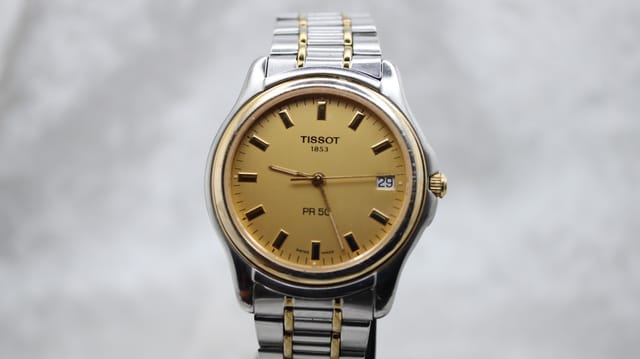
Tissot reference numbers explained: how to read the code on your case back and date your watch
What codes like J376/476, C276K, Z173K and T063.617 on a Tissot case back mean, what they can and cannot tell you about age, and how to date the watch properly.
The code on the back of a Tissot is a model reference, not a date. An older code such as C276K, Z173K or J376/476 identifies the case design and the family it belongs to, while a modern code such as T063.617.16.037.00 spells out the collection, case, strap and dial. To date the watch you combine that reference with the serial number, the movement calibre and, where it matters, a paid archive search from Tissot itself.
This guide explains how to read both kinds of code, what the serial number can and cannot tell you, and which references we have actually handled at London Watch Market, with the eras and prices from our own records.
Where to find the reference on a Tissot
Turn the watch over. On almost every Tissot the reference is engraved or printed on the case back, usually around the edge or in a line across the centre, alongside "Swiss made", the water resistance and, on many pieces, a serial number. Tissot's own help pages describe the modern reference as starting with a T followed by a string of digits, found on the back of the watch.
On quartz Tissots of the 1980s, 1990s and early 2000s the reference is a short code of a letter and three digits, sometimes two sets of digits divided by a slash, often with a letter on the end: C225K, G327, L720, J326/426K, T830/930. Next to it there is often a separate group of letters and numbers, such as QKS-JA 11993. That is an individual marking, not the model code, so search with the first code only.
On the modern Tissots we handle, the case back usually shows a shortened form of the reference, such as T063617A or T049.210.A, rather than the full thirteen characters. The full version appears on the box label, the warranty card and Tissot's own product pages.
How to read an older Tissot code like C276K
Here is the honest answer: Tissot has never published a key to its older case codes, and we have not found a reliable source that decodes the first letter as a year or the digits as a specification. Collectors on the main forums have made the same point: there is no public reference book for these numbers.
What the codes do reliably tell you is the model. The same code on two case backs means the same case design, so the code is the fastest way to find matching examples, original photographs and fair prices. Across the nearly two hundred Tissots in our own records, the first letter also tends to cluster by family, which is a useful hint when a watch has lost its dial branding or its box:
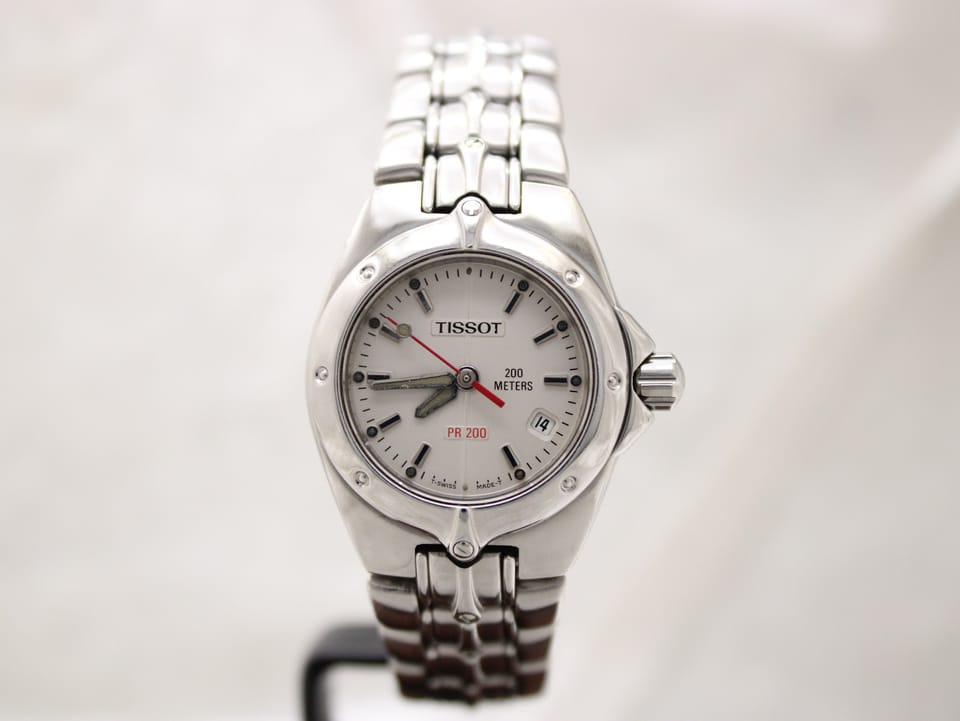
J: the PR 50, in codes such as J126/226K, J176/276K, J326/426K and J376/476.
P: the PR family more broadly, including PR 100 (P320/420, P365/465), PR 200 (P130/230) and the PRX quartz models (P340, P380).
V: the Stylist, in codes such as V135/235.
C: dress models including the Ballade (C277/377W) and the slim C225K, C226K and C276K.
G: small ladies' models, many signed 1853, such as G327, G330 and G350.
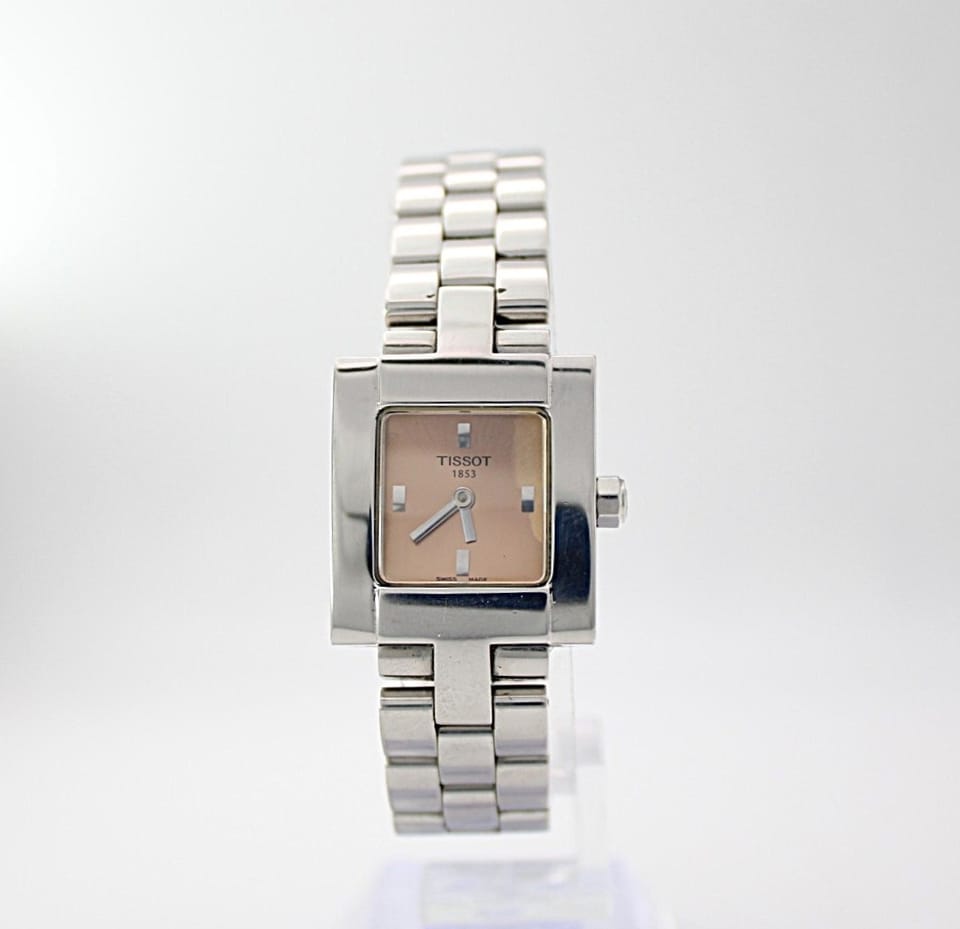
L: square and rectangular ladies' models such as L720, L730K and L910.
T followed by 8: classic round dress watches such as T825/925, T830/930 and T870/970.
Treat these groupings as a pattern in the watches we have handled, not as Tissot's own system. The same goes for the trailing letter: K is by far the most common, and we have seen T on some titanium PR 50s, but we have no reliable source for what either letter means and would not buy or sell on that basis.
What the slash in J376/476 means
A slash code such as J376/476 or T870/970 carries two numbers for one case. In our records the pairing is fixed to one watch size: J176/276K and J376/476 are men's PR 50s of about 36mm, while J326/426K is a ladies' PR 50 of about 24mm. Since the men's and the ladies' versions each carry their own pair, the slash cannot simply mean one number for men and one for women.
The common explanation is that the two numbers cover variants of the same case, such as different finishes or bracelet and strap versions, but we have not found Tissot documentation that confirms it. For practical purposes, search with the whole code including the slash, since that is how dealers and auction houses write it. Searching "J376/476" will find like-for-like watches; searching "J376" alone will mix in unrelated ones.
How to read a modern Tissot reference
Modern Tissots carry a structured reference of a T and five groups, for example T063.617.16.037.00. Read left to right, the groups give the collection, the case and movement variant, the case material and fitting, the dial and a final variant code. In that example, 063 is the Tradition collection and 617 the chronograph version, which is why T063.617 turns up on the Tradition Chronograph and T063.610 on the three-hand Tradition.
The middle pair of digits is the one worth learning. On the current Everytime 40mm, Tissot's own page lists T143.410.16.041.00 as a steel case on a black leather strap, while retailers list T143.410.11.011.00 as steel on a steel bracelet. The Tradition Chronograph T063.617.16.037.00 is likewise steel on leather. So a 16 in that position has consistently meant steel on leather, and 11 steel on a bracelet, in the pairs we have checked. The dial group changes with dial colour, as 041 (blue) and 011 (silver) do in the Everytime pair.
A modern reference dates a watch only loosely: it tells you the collection, and each collection has a known launch period, but the same reference can be sold for many years. The T049 prefix, for instance, is the PR 100, a line we have handled on watches from the 2000s and 2010s.
Can the serial number date my Tissot?
Sometimes, and mostly for older watches. Published tables map Tissot movement numbers to years from the 1850s to 1976, and case-back serial numbers to years from 1977 to 1983. If your watch falls in that period and the number is legible, the tables will usually give you a year or two, which the compilers themselves describe as an estimate rather than an exact date, since a movement and its case were not always made at the same time.
After the early 1980s it gets much harder. The published tables stop at 1983, at least one reference site states that Tissot stopped using date-decodable serial numbers in the 1980s, and no reliable table we know of covers the quartz decades. The letter groups on 1990s and 2000s case backs, such as RKS-HA or SKL-BC followed by digits, have no published key, so we do not use them to date a watch. Since 2014 Tissot has engraved a Watch-Secure (WS) code on its watches, which is for warranty registration and authentication, not for dating.
The one source that can give an exact answer is Tissot. Owners who have used its heritage service report a paid "extract from the archives" for watches no longer in the current collection, requested through Tissot customer service with photographs of the watch and its movement. The fee reported is 100 Swiss francs, charged only if the search succeeds, and it can take up to two months. The document records what Tissot's archive holds on the watch, but Tissot is clear that it does not guarantee authenticity. Check the current terms with Tissot before you apply.
Cross-checking with the movement calibre
The movement is the other half of the evidence. Most quartz Tissots use a Swiss ETA calibre (both companies belong to the Swatch Group), and the calibre number is printed on the movement and visible once a watchmaker opens the case back. Every calibre has a production window, and a watch can be no older than its movement's introduction. The modern Tradition Chronograph, for example, is listed with the ETA G10.211.
Published production dates for individual ETA quartz calibres disagree more than you might expect, so treat any single source with care. The calibre is best used as a consistency check: if the case code, the calibre and the dial style all point to the same decade, you can trust the date. If one of them does not fit, that is worth asking about. Our general guide on how to date a vintage watch covers the same method across other brands.
Tissot references we have handled
The list below comes from our own stock and sales records. The era is our own estimate, recorded when each watch was catalogued, and the prices are what buyers paid us, rounded, from our sales. Figures from single sales are shown as such and are a guide, not a valuation.
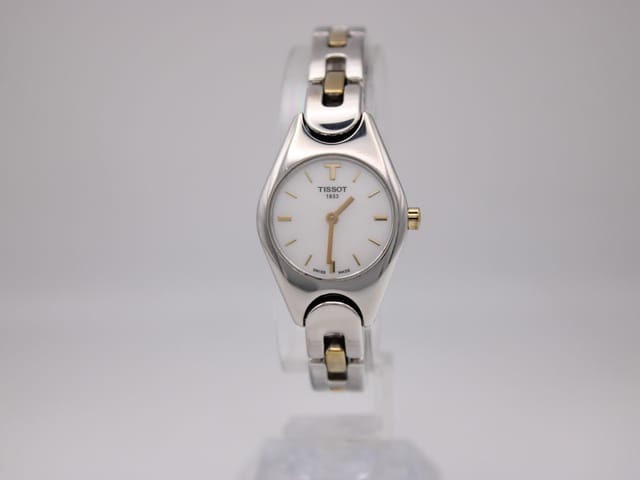
J326/426K: PR 50, ladies' 24mm steel or two-tone. 1990s. Seven sales, mostly £120 to £160, one international sale at about £230.
J176/276K: PR 50, men's 36 to 37mm. 1990s. Two sales, £135 to £160.
J376/476: PR 50, men's 36mm. 2000s in our records. No sale yet; we have a blue-dial J376/476 in stock at £165.
T870/970: classic men's dress watch, about 34 to 36mm. 1990s. One sale at about £240; we currently have a two-tone T870/970 at £185.
T830/930: classic dress watch, 27 to 29mm. 1990s. Two sales, £100 to £175.
T825/925: ladies' classic, about 24 to 26mm. 1990s. Four sales, £105 to £150.
C276K: slim gold-tone dress watch, 32mm. 1990s. One sale at about £190.
C226K: ladies' dress watch, about 23mm. 1990s. Two sales, £105 to £135; a two-tone C226K is in stock.
C225K: ladies' dress watch, 23mm. 1990s to around 2000. Two sales, £75 to £85.
Z173K: rectangular tank watch, 22mm. 1990s. One sale at £650, well above anything else here, which reflects how sought after the model is. See our Z173K reference page.
V135/235: Stylist, ladies' gold-tone, about 25mm. 1990s. Three sales, £130 to £145.
G327: ladies' two-tone, 22mm. 1990s. One sale at £80.
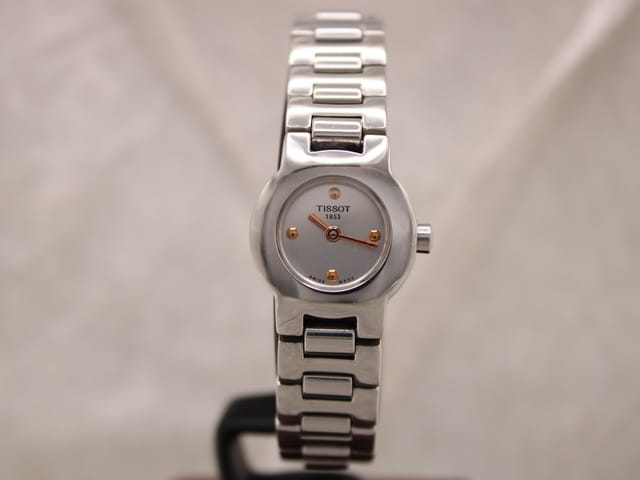
G330 to G350: small ladies' models on integrated bracelets. 1990s and 2000s. Seven sales, mostly £85 to £130, one at about £210.
L720: ladies' steel with sapphire crystal. 2000s. Two sales, £130 to £150.
P130/230: PR 200, ladies'. 1990s. One sale at about £140.
T049.410: PR 100, men's 38mm. 2000s. One sale at £200.
T063.610 and T063.617: Tradition and Tradition Chronograph, about 41 to 42mm. 2010s. One T063.610 sale at £180; a T063617A chronograph is in stock at £255.
R150: RockWatch with a stone case. Late 1980s and 1990s. Four sales, £135 to £230 depending on the stone.
For the PR 50 specifically, our PR 50 reference page and the Tissot PR50 buying guide go into the variants in more depth. Everything currently in stock is on our Tissot page.
How to use the code to check a watch before buying
The reference is your best tool for checking that a watch is what it claims to be. Search the exact code and compare the listing against several other examples: case shape, size, crown, bracelet and dial layout should all match. A C276K described as a 38mm sports watch, or a J326/426K listed as men's, is a sign that the case back and the description do not belong together.
Then check that the parts agree with each other. The case code, the movement and the dial style should all sit in the same era, as described above. Replacement straps and crowns are common at this age; they should simply be declared.
Finally, be sceptical of any seller who gives an exact year from a 1990s case code alone. The code gives the model and a rough era; an exact year needs a serial table, a calibre date or Tissot's archive. At London Watch Market we state our year as an estimate, and give a decade where that is all the evidence supports. If you want to see which older Tissots are most worth owning, our guide to the best vintage Tissot watches is a good next read.